
Theory
THE IMPORTANCE OF ROLLER DIAMETER
On chassis dynamometers, the diameter of the rollers is one of the main limiting factors for measurable power.
This limit is imposed by the maximum speed attainable on the test bench, which is determined by two factors:
- Outer diameter of dyno rollers
- Maximum speed in rpm of the support bearings used in the test bench
The upright supports (bearings) available on the market, suitable for the diameters and weights required for this type of use, are certified for maximum speeds around 3,000 rpm (with a few exceptions at 3,500 rpm).
Accordingly, given the diameter of the rollers (and their circumference) we can deduce the maximum speed attainable on the test bench (knowing that each roller revolution obviously corresponds to a given mileage).
For the purposes of the calculations set out below, we have taken as references:
- i highest-performance bearings available, certified to 3,500 rpm
- i Popular roller diameters between the various producers:
MAXIMUM SPEEDS ON CHASSIS DYNAMOMETERS
- 240 mm rollers – Maximum speed 158 km/h
- 318 mm rollers – Max. speed 210 km/h
- 400 mm rollers – Max. speed 264 km/h
The Sport Devices chassis dynamometers are equipped with:
- 500 mm rollers – Max. speed 330 km/h
- 635 mm rollers – Max. speed 419 km/h
A large-diameter roller is also of fundamental importance, in order to avoid tyre slippage during bench tests (which would generate power reading losses),
This thanks to the natural and is wider contact surface between tyre and roller.
TYRE INDENTATION
The smaller this contact area between tyre and roller, the higher the shear load ('indentation'), operating on the contact surface of the tread.
These forces, not foreseen in the normal design of road tyres, deform and continuously stress the side walls during bench tests.
Combining high power and high speed, with small diameter rollers, this high deformation (indentation) can overheat the tyres, with the risk of compromise both their integrity and the results of the tests.

Single-roller dynamometer
SINGLE-ROLLER CHASSIS DYNAMOMETERS
Single-roller chassis dynamometers, as vehicle power increases, have over time become the most popular solution among all the different manufacturers of chassis dynos.
As we can see from the analysis below, tyres find their optimal operating conditions on the road (image A).
Looking at the simulations below (images B and C) we can observe how at the larger diameter of the roller, corresponds to less 'indentation' and thus less stress (image. B) for tyres, also obtaining:
- Increased grip (larger contact area)
- Improved maintenance of constant operating conditions, during testing

TWIN-ROLLER DYNO TEST BENCHESE
Originally born for diagnostic needs (at a time in history when vehicles had much lower powers than today) offered good stability of the vehicle under test, but sacrificed tyre retention.
This design choice was at the time also justified by the purposes for which the double-roller bench was originally designed; or its use within diagnostic centres that they were merely doing short and quick power tests.
HIGH STRESS CONDITIONS FOR TYRES
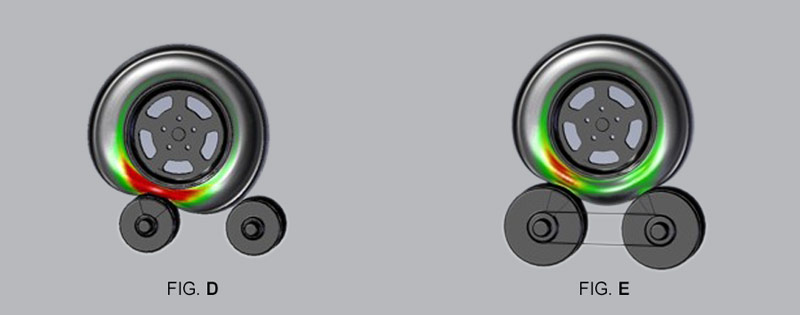
As can be seen from the figures below (images. D, E) the car or motorbike test bench with double rollers (whether connected by a belt or not) submit anyway tyres under high stress conditions, also due to high indentation due to theimpossibility of using large-diameter rollers, implicit in these solutions.
INCREASINGLY POWERFUL OF MODERN VEHICLES
These stressful conditions become increasingly evident as the power and torque of vehicles increase.
We therefore think of the modern endothermic, hybrid or electric vehicles, the torque and power of which have grown disproportionately in recent years, reaching more than double levels compared to the powers for which this type of bench double rollers was initially put on the market (1980s).
Typically, conducting medium/long-term tests, tyre warm-ups are likely to affect the results; due to:
- different grip in tyre/roller contact at different temperatures (cause of energy dissipation and variation of wheel power readings and the power dissipated.
- tyre diameter variations, which could occur due to their increased internal pressure with possible differences in engine speed readings.
DIFFERENT WHEEL AND ROLLER SPEEDS
Further criticality of double roller dyno test benches is represented by the different rotation speeds of tyres and rollers.
During the acceleration period, tyres naturally tend to want to 'go up' on the front roller (image D), deforming even more due to displacement and different vehicle mass distribution.
This also involves the displacement of wheel and roller centres of rotation (and relative rolling diameter), modifying rotation speeds accordingly of the individual components involved (front roller/rear roller/tyre).
For understand this dynamic, one only has to look at Fig. D and E below; the distances from the axes of rotation from the centre of rotation of the tyre, change as the position of the vehicle axle changes.
This creates two different possible operating conditions, depending on the presence or not a mechanical constraint between front and rear rollers:
- When NOT bound together (Image D), the rear roller rotates at a higher rotational speed, condition that can cause slippage and adversely affect tests
- When bound together (image E), the rear roller carries a rubbing effect on the tyre surface, due to its lower rotational speed in this case; thus increasing tyre wear and operating temperature.

Double roller chassis dynamometers
INSIGHTS
- History of chassis dynamometers
- What is power dissipation?
- Advantages of 4×4 dynos with linked axles
- Power correction factors DIN, CE, SAE..
- Homologation and C.O.P. test benches fields of application
- Contact us: for more information